
The 2026 Guide to Secure, HIPAA-Compliant Healthcare Automation
The complete compliance guide for AI medical receptionists — HIPAA, PIPEDA, BAA management, encryption standards, identity verification, escalation protocols, and vendor vetting.
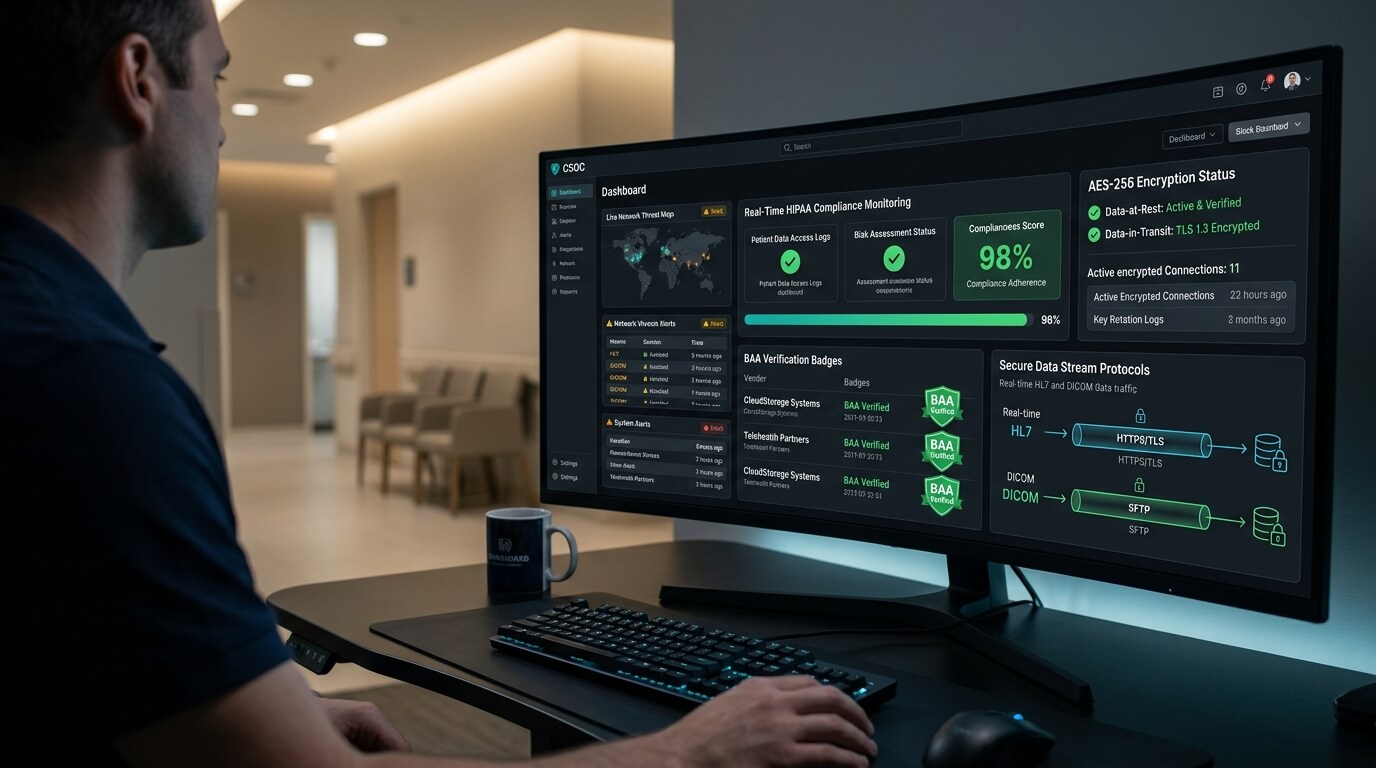
Why HIPAA-Compliant Healthcare Automation Is the Core Trust Layer
You’ve seen the operational ROI of automated clinics. But none of it matters without strict HIPAA-compliant healthcare automation to safeguard patient trust and protect against catastrophic regulatory breaches.
The AI books appointments, reduces no-shows, and captures after-hours revenue. But a single compliance failure can shut you down. Healthcare compliance isn’t a checkbox — it’s the foundation that makes integrating front desk automation possible.
Every workflow we’ve covered in previous pillars (booking, reminders, waitlists, EHR integration) processes Protected Health Information (PHI). A single misrouted SMS, an unencrypted call recording, or a vendor without a BAA can trigger:
- Civil penalties: $100–$50,000 per violation (up to $1.5M/year per category)
- Criminal penalties: Up to $250,000 and 10 years imprisonment
- Reputational destruction: 60% of patients leave after a breach
- Contractual liability: Payer contracts terminated, BAAs enforced
This guide is for the compliance buyer — the practice manager, privacy officer, or clinical lead who needs to know exactly what “HIPAA-compliant AI” means in practice. Not marketing claims. Technical specifications, contractual requirements, and operational procedures.
HIPAA 101 for AI Receptionists: What Actually Applies
An AI medical receptionist doesn't just “touch” PHI — it creates, receives, maintains, and transmits it across multiple channels.
HIPAA Rules That Apply to AI Receptionists
| HIPAA Rule | Applicability | Key Requirements |
|---|---|---|
| Privacy Rule | Full | Minimum necessary, patient rights, authorization |
| Security Rule | Full | Administrative, physical, technical safeguards for ePHI |
| Breach Notification | Full | 60-day notification, HHS reporting, media if >500 affected |
| Omnibus Rule | Full | BAA requirements, subcontractor flow-down, marketing rules |
| Enforcement Rule | Full | Investigations, penalties, corrective action plans |
What “HIPAA-Compliant AI” Actually Means (Technical)
| Control Area | Requirement | Implementation |
|---|---|---|
| Encryption at Rest | AES-256 for all stored PHI | Database encryption, file encryption, backup encryption |
| Encryption in Transit | TLS 1.2+ for all PHI movement | API calls, webhooks, SIP/TLS for voice, SMPP/TLS for SMS |
| Access Control | Unique IDs, role-based, MFA | RBAC, principle of least privilege, session management |
| Audit Controls | Immutable logs of all PHI access | Who, what, when, where, why — tamper-evident |
| Emergency Access | Break-glass procedures documented | Clinician override with full audit trail |
The Business Associate Agreement (BAA): What You Need to Know
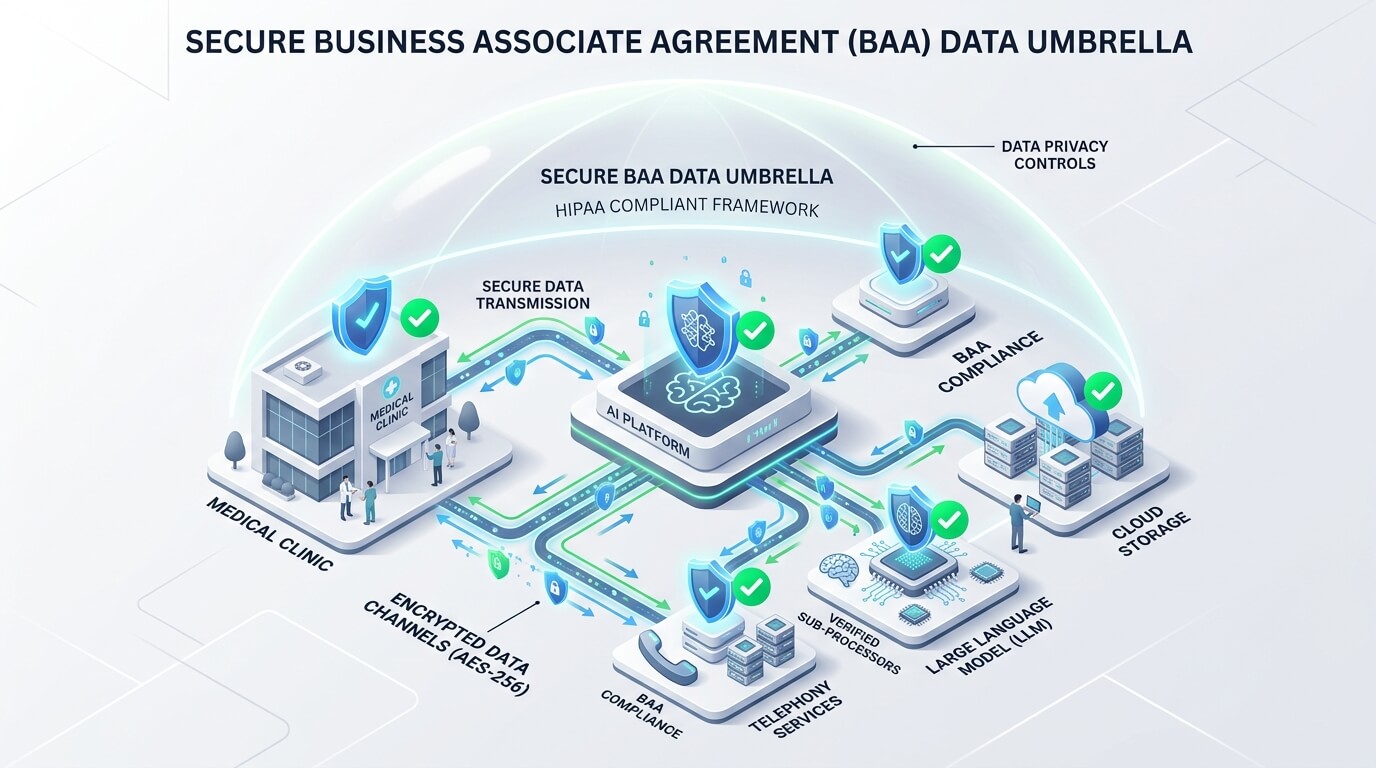
No BAA = No HIPAA compliance. Period. Every AI vendor processing PHI on your behalf must execute a BAA before go-live.
The Subcontractor Trap (Where Most BAAs Fail)
Every single subcontractor touching PHI must have a BAA with the AI vendor, and the vendor must flow down your BAA terms. Ask for the subcontractor list with BAA status before signing.
BAA Red Flags
| Red Flag | Why It Matters |
|---|---|
| “We’re HIPAA-compliant but don’t sign BAAs” | Walk away — legally impossible |
| “Our BAA doesn’t cover subcontractors” | You own their breaches |
| “Breach notification in 60 days” | You need 24–48 hours to meet your 60-day clock |
| “No audit rights” | Can’t verify compliance |
| “No cyber insurance requirement” | Vendor breaches = your financial risk |
Data Encryption Standards for Medical Voice AI
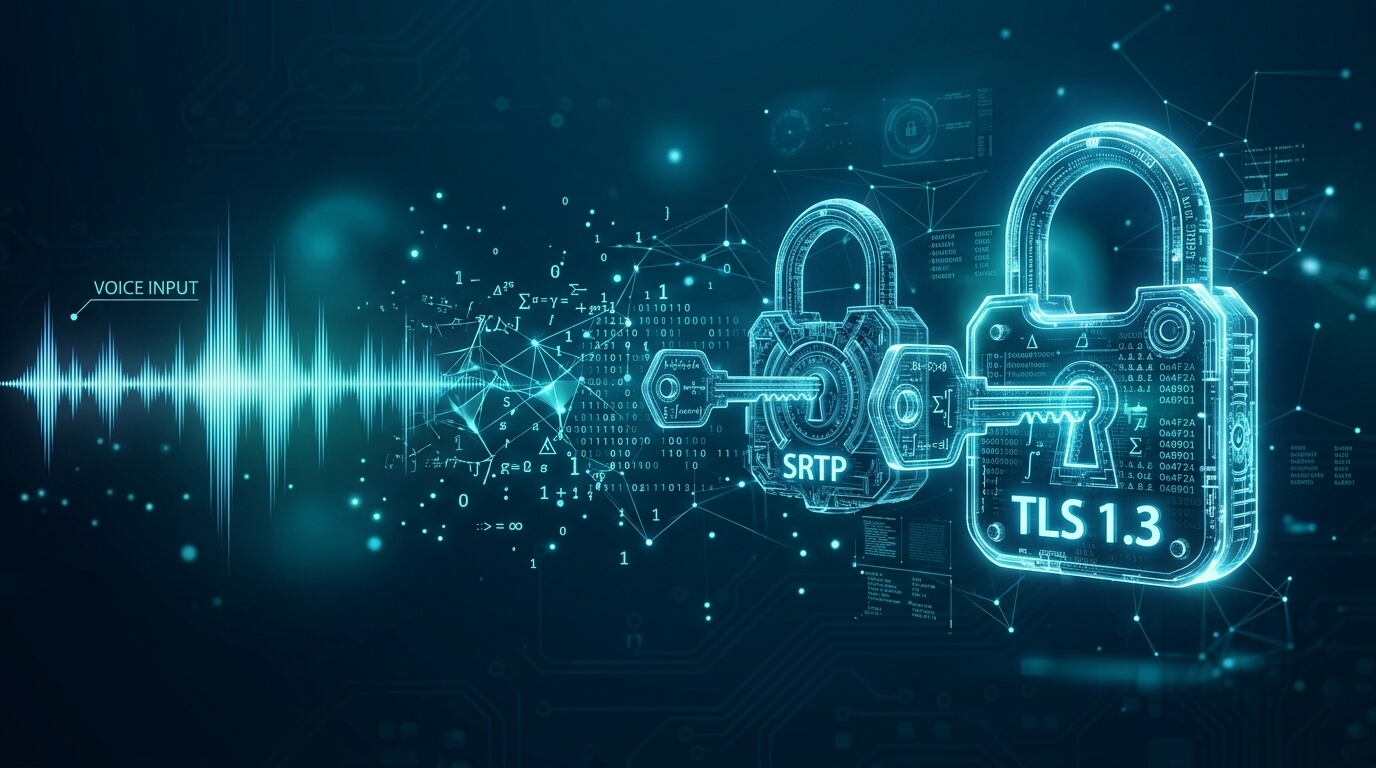
Integrating HIPAA-compliant healthcare automation introduces unique encryption challenges: real-time audio streams, recordings, transcripts, and derived clinical data.
| Data State | Standard | Implementation |
|---|---|---|
| Audio Streams (Live) | SRTP | AES-256-GCM, DTLS-SRTP key exchange |
| Call Recordings | AES-256 + TLS 1.3 | Encrypted object storage (S3 SSE-KMS, GCS CMEK) |
| Transcripts | AES-256 + TLS 1.3 | Database encryption (TDE), field-level encryption for PHI |
| Clinical Notes | AES-256 + TLS 1.3 | Same as transcripts + digital signature for integrity |
| API Payloads | TLS 1.3 | mTLS for EHR/PMS/CRM connections |
How AI Receptionists Securely Verify Patient Identity

Identity verification is the gatekeeper. Get it wrong, and you’re disclosing PHI to the wrong person — a reportable breach.
| Channel | Low Risk (Booking) | Medium Risk (Refill) | High Risk (Clinical Info) |
|---|---|---|---|
| Voice (AI) | DOB confirmation | DOB + last 4 SSN | Voice biometric + knowledge |
| SMS | Portal link + DOB | Portal link + OTP code | Secure portal login required |
| Web Chat | Session-authenticated | Portal re-auth + OTP | Portal MFA + knowledge |
What NOT to Do (Common Violations)
- Don't: Ask for full SSN in SMS. Do: Use portal link + OTP.
- Don't: Verify via caller ID only. Do: Use Caller ID + knowledge factor.
- Don't: Email PHI to a patient. Do: Send a secure portal message link.
- Don't: Leave clinical info on voicemail. Do: Leave generic "Call us back" message.
Configuring AI Escalation Protocols for Clinical Safety
AI never makes clinical decisions. It detects, routes, and escalates. The escalation configuration is where clinical safety lives.
Secure SMS vs. Standard SMS for Patient Communications
Standard SMS is not HIPAA-compliant for PHI. It’s unencrypted, stored on carrier servers, visible on lock screens, and not access-controlled.
| Risk | Standard SMS | Secure SMS (Portal Link) |
|---|---|---|
| Encryption in Transit | None | TLS 1.3 (link) |
| Encryption at Rest | Carrier stores plaintext | Not stored in SMS |
| Lock Screen Visibility | Full message visible | Generic “message from clinic” |
| Access Control | None | Portal authentication |
The Secure SMS Pattern (Recommended)
PIPEDA & Cross-Border Compliance for Canadian Clinics
If you serve Canadian patients, PIPEDA applies — and it’s stricter than HIPAA in key ways.
| Aspect | HIPAA (US) | PIPEDA (Canada) |
|---|---|---|
| Consent | Implied for Treatment, Payment, Ops | Explicit meaningful consent required |
| Breach Notification | 60 days (HHS + patients) | “As soon as feasible” (no fixed deadline) |
| Cross-Border Transfer | BAA sufficient | Comparable protection required; notify if foreign gov access |
| Data Minimization | Minimum necessary | Explicit requirement — collect only what’s needed |
State-Level Privacy Laws: California, Texas, New York & Beyond
US state privacy laws create a patchwork. Most state laws exempt “PHI under HIPAA” — but only for HIPAA-covered entities.
| Scenario | State Law Applies? |
|---|---|
| HIPAA-covered clinic + HIPAA-covered AI vendor | No (PHI exempt) |
| Non-covered entity (med spa, direct-to-consumer) | YES — full state law applies (CCPA, TDPSA, etc.) |
| HIPAA-covered clinic + non-covered vendor | YES for vendor; clinic still HIPAA |
| Patient in CA, clinic in TX | CA law applies (residency-based) |
A Clinic Manager’s Checklist for Vetting Secure SaaS Vendors
Use this before signing any AI receptionist contract to ensure HIPAA-compliant healthcare automation.
- BAA & Subcontractors: “Will you sign our BAA? List all subprocessors with PHI access.” (Must provide complete list and BAA flow-down).
- Certifications: “SOC 2 Type II? HITRUST? ISO 27001?” (SOC 2 Type II is the minimum).
- Penetration Testing: “Annual third-party pen test?” (Require summary report).
- Encryption: “AES-256 at rest? TLS 1.3 in transit? SRTP for voice?” (All must be yes).
- Access Control: “RBAC? MFA? Session timeouts?”
- Breach Notification: SLA must be 24-48 hours, not 60 days.
- Liability & Cyber Insurance: Require $5M+ cyber insurance policy from the vendor.
Audit Readiness: Documentation, Logging & Incident Response
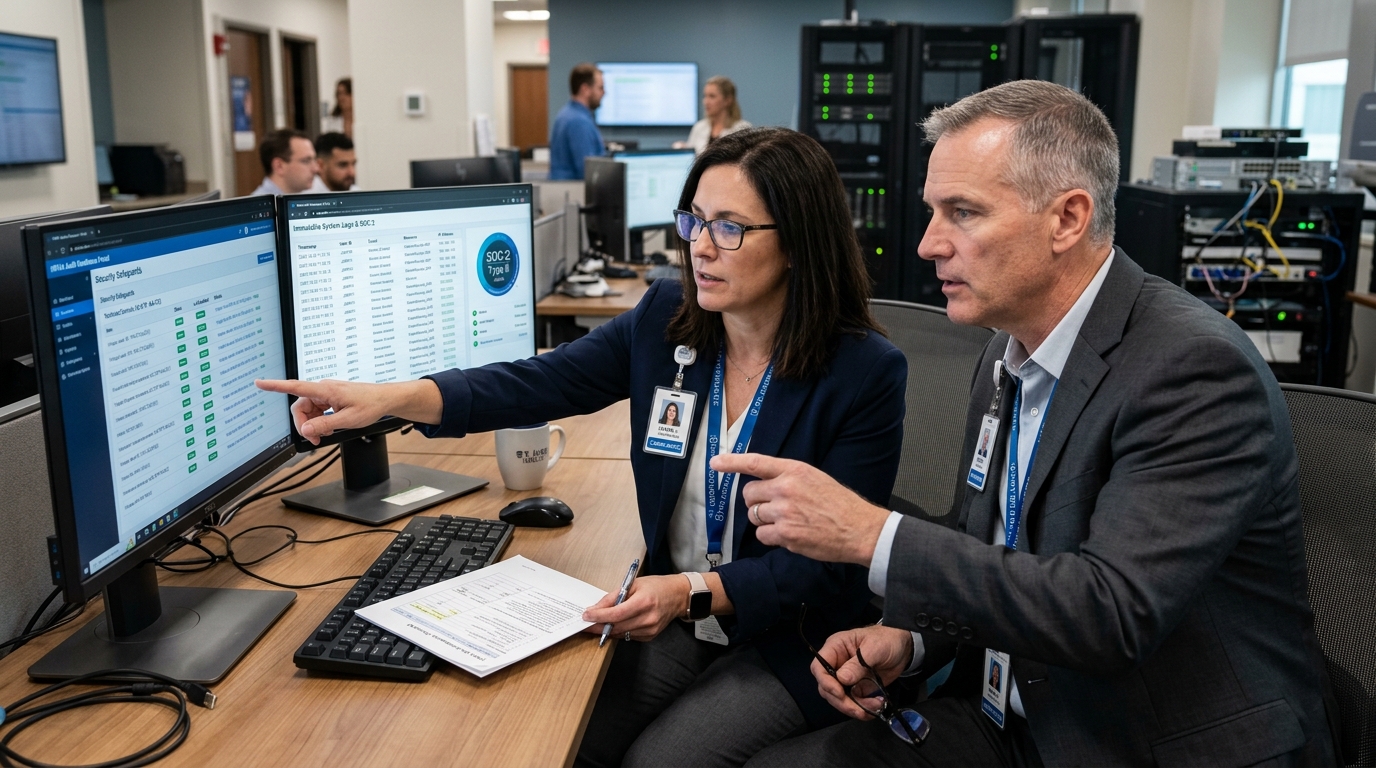
Compliance isn’t a point in time — it’s a continuous state of evidence for your HIPAA-compliant healthcare automation stack.
Incident Response Playbook (HIPAA Breach)
Frequently Asked Questions
Do we need a BAA with our AI vendor?
Yes, absolutely. Any vendor creating, receiving, maintaining, or transmitting PHI on your behalf is a Business Associate. No BAA = HIPAA violation. Execute before any PHI flows.
What if our AI vendor uses OpenAI/Anthropic for LLM processing?
The LLM provider is a subcontractor. Your vendor must have a BAA with them, and flow down your BAA terms. Ask for the subcontractor BAA list. If the LLM provider won’t sign a BAA (OpenAI doesn’t for standard API), the vendor must use a HIPAA-compliant deployment (Azure OpenAI, AWS Bedrock, dedicated instances with BAA).
Is standard SMS okay for appointment reminders?
Only if ZERO PHI in the message. “You have an appointment tomorrow at 2 PM” = OK. “Your dermatology follow-up for psoriasis tomorrow at 2 PM” = NOT OK (diagnosis = PHI). Use portal links for any clinical context.
Do we need patient consent to record calls?
Depends on state. 11 states require all-party consent (CA, FL, IL, MD, MA, MI, MT, NH, PA, WA). Best practice: announce recording at call start (“This call may be recorded for quality”) and capture verbal consent. Document consent in call metadata.
What encryption do we need for voice AI?
SRTP (Secure Real-time Transport Protocol) with AES-256-GCM for live audio streams. AES-256 at rest for recordings. TLS 1.3 for all API/webhook traffic. Keys managed in HSM/cloud KMS with annual rotation.
How does AI handle medical emergencies?
Immediate escalation. Clinical keyword detection (chest pain, stroke signs, suicidal ideation) triggers: 1) Warm transfer to on-call, 2) If unavailable → 911 script + page backup, 3) Full transcript logged. AI never gives medical advice.
What about PIPEDA for our Canadian patients?
PIPEDA applies. Key differences: explicit meaningful consent required (not implied), “as soon as feasible” breach notification, comparable protection for cross-border transfers. Quebec Law 25 is stricter — privacy officer, PIAs, data portability, right to be forgotten.
Do state privacy laws (CCPA, etc.) apply to our clinic?
HIPAA-covered PHI is exempt from most state laws — but only for HIPAA-covered entities. If you’re a med spa, wellness clinic, or direct-to-consumer service not covered by HIPAA, full state law applies. Map patient residency; meet strictest standard universally.
What’s our liability if the AI vendor has a breach?
You’re ultimately responsible for your patients’ PHI. BAA should include: vendor liability for their breaches, cyber insurance ($5M+), indemnification, no liability cap for breach. You still notify patients/HHS — vendor reimburses costs.
How do we audit our AI vendor’s compliance?
Annual: Review SOC 2 Type II / HITRUST, penetration test, subcontractor BAA status, audit log samples, access control matrix, incident response drill. Quarterly: Review breach log, access reviews, configuration changes. Ongoing: Automated alerting on anomalies.
Ready to verify your AI vendor’s compliance posture?
Book a 30-minute compliance assessment — we’ll review your BAA, audit logs, encryption architecture, and vendor contracts against HIPAA, state laws, and PIPEDA requirements.